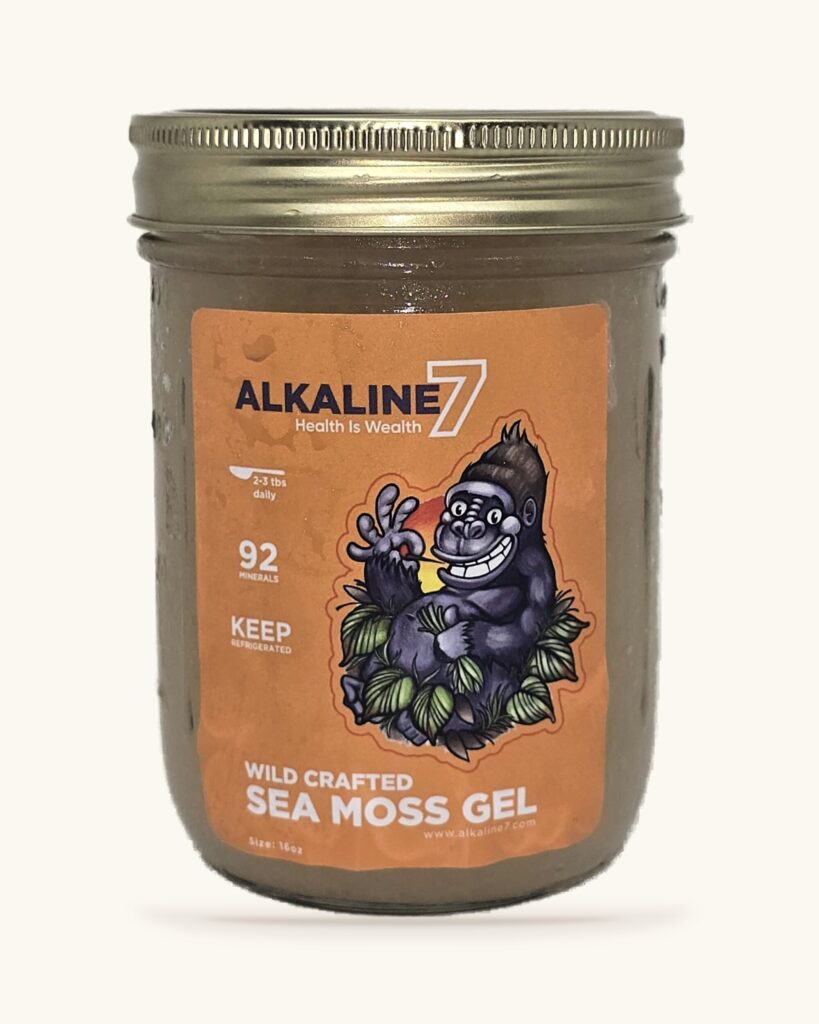
Almost always because the gel is doing what gels do. Carrageenan networks release some of the water they hold as they stand; the term is syneresis, and a thin clear layer stirs straight back in. It only means something else when the liquid is copious and the gel refuses to recombine, or a smell or gas signal has changed too.
What we verified — 2026-08-23
The gelling mechanism and the freeze-thaw water release are quoted from the FAO’s carrageenan reference chapter and peer-reviewed carrageenan literature. The this is a natural product, contents may vary line is printed on every Alkaline7 panel and is quoted as label text. Nothing on this page is product-specific laboratory testing; it is food science applied to a jar.
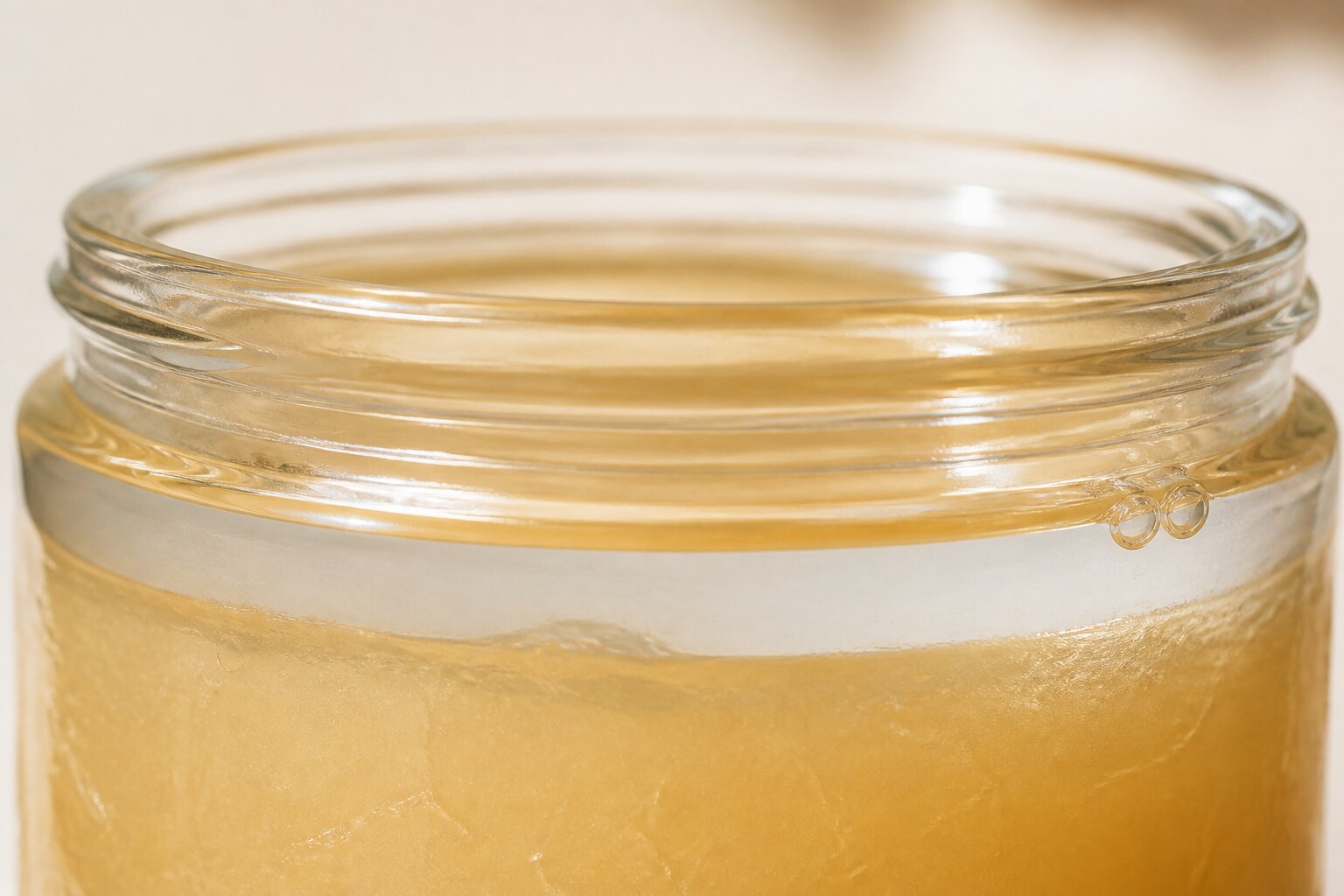
Normal, or not normal?
This is the whole page in two columns. Check the jar against the left column first; the right column is rarer than the internet suggests.
| Normal — stir it in and carry on | Not normal — stop |
|---|---|
| A thin layer of clear or faintly cloudy liquid on top | A large pool of liquid and a gel that stays broken however much you stir |
| The gel underneath still has body and ribbons off a spoon | The gel has gone thin all the way through and will not recombine |
| The jar smells the way it did on day one — faintly of the sea, or of its fruit | A sour, fermented, yeasty, or alcoholic smell |
| Weeping after a spell in the freezer, or after a jar has stood a couple of weeks | Fizzing, bubbling, or a lid that has bulged or hisses |
| A jar that is firmer or looser than the last one you bought | Fuzzy spots of any colour, on the surface or the rim |
Anything in the right column is a spoilage question, not a texture question — go to how long does sea moss gel last and discard rather than taste.
What syneresis actually is
The reason sea moss turns into a gel is structural, not additive. Sea moss contains carrageenan, a family of long sugar molecules the seaweed uses as cell-wall material. Blend soaked moss with water and those molecules unwind; as the mixture cools they link into a three-dimensional mesh that traps the water. What you spoon out of the jar is, overwhelmingly, water held in a carrageenan scaffold.
The mesh is physical, not permanent. Carrageenan gels release water on standing. The FAO’s reference chapter notes that kappa-carrageenan gels “are subject to syneresis,” and that “much water separates from the gel when it is frozen and then allowed to thaw.” A thin layer of clear liquid on a jar is the scaffold relaxing, not a spoilage signal — and it is the same phenomenon you see as whey on a pot of yoghurt.
Two things reliably increase it: time, because the network keeps contracting slowly for as long as it sits, and a freeze-thaw cycle, because ice crystals tear the mesh as they grow and the water they held is no longer fully captured. If your jar wept badly after a stint in the freezer, that is the expected outcome and the freezing guide covers what to do with it.
How to stir it back in
Technique matters more than effort here, because over-working a set gel breaks the network you are trying to rebuild.
Use a clean dry spoon and work from the bottom of the jar upward, folding rather than beating, until the liquid disappears into the body. Ten or fifteen seconds is usually enough. If the jar is very full, take a serving out first so you have room to move. For a jar that has thawed and is genuinely loose all through, a few seconds with an immersion blender does more than a minute of stirring — but that is a rescue, not a routine, and the result will be silkier and slacker than a fresh jar.
What not to do: don’t pour the liquid off. It is water the gel was holding, and pouring it away leaves you with a stiffer, smaller jar rather than a better one.
Why one jar is firmer than the last
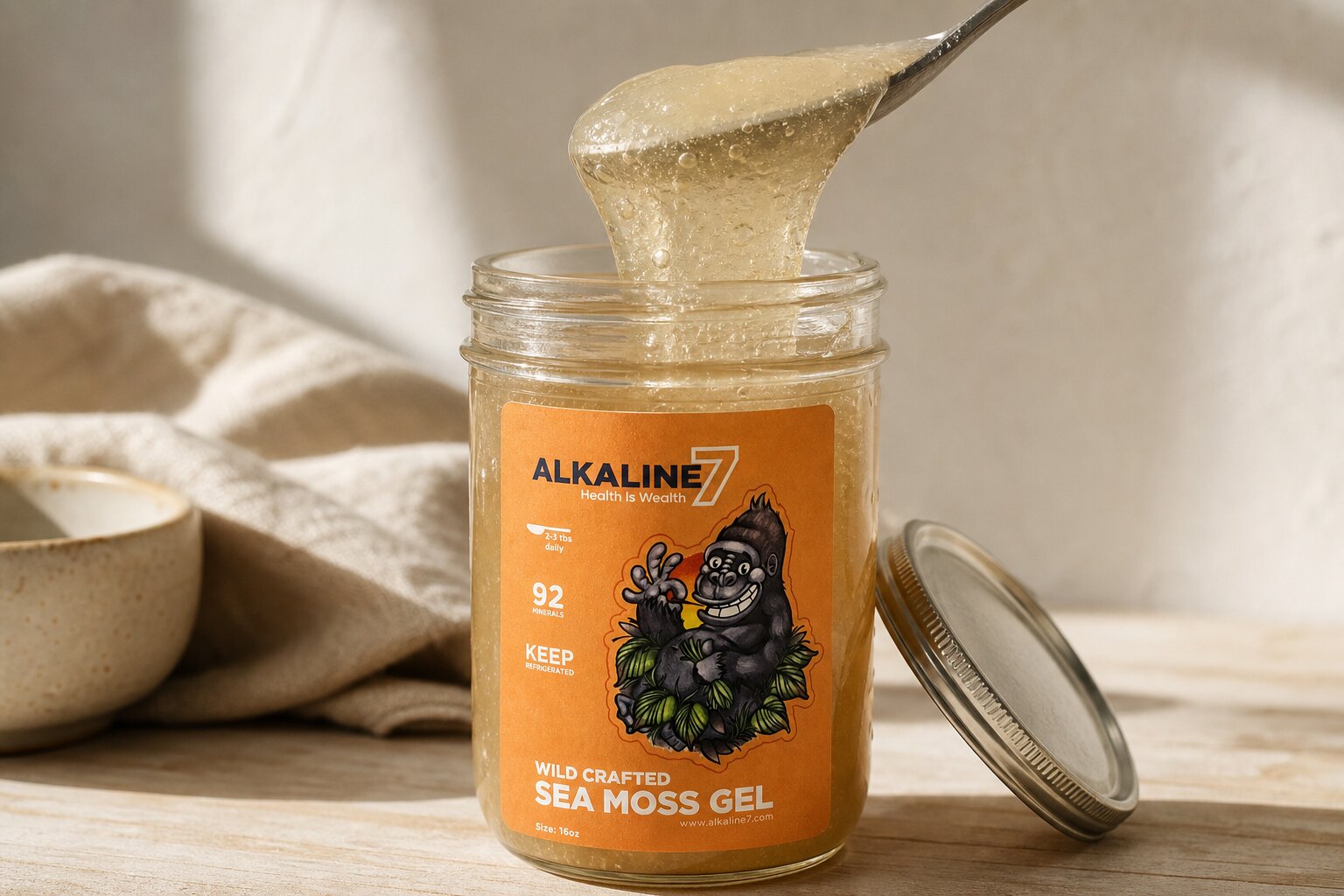
Every Alkaline7 panel closes on the same four words: this is a natural product, contents may vary. That line is doing real work on this page.
A jar of gel is seaweed, water, and — depending on the jar — fruit, herbs or spices. Sea moss is a harvested seaweed, not a standardised ingredient: the ratio of gelling to non-gelling polysaccharide shifts with species, harvest, and season, and the amount of water a given batch of moss will take up shifts with it. A batch that gels a little harder makes a firmer jar; a batch that gels a little softer makes one you can pour.
The sweeter and fruit-led jars are structurally looser than the plain one, too, because sugar and fruit purée slacken the network. If you moved from the plain jar to Elderberry & Mixed Berry and thought the gel had gone wrong, it hadn’t — that jar is the loosest of the five.
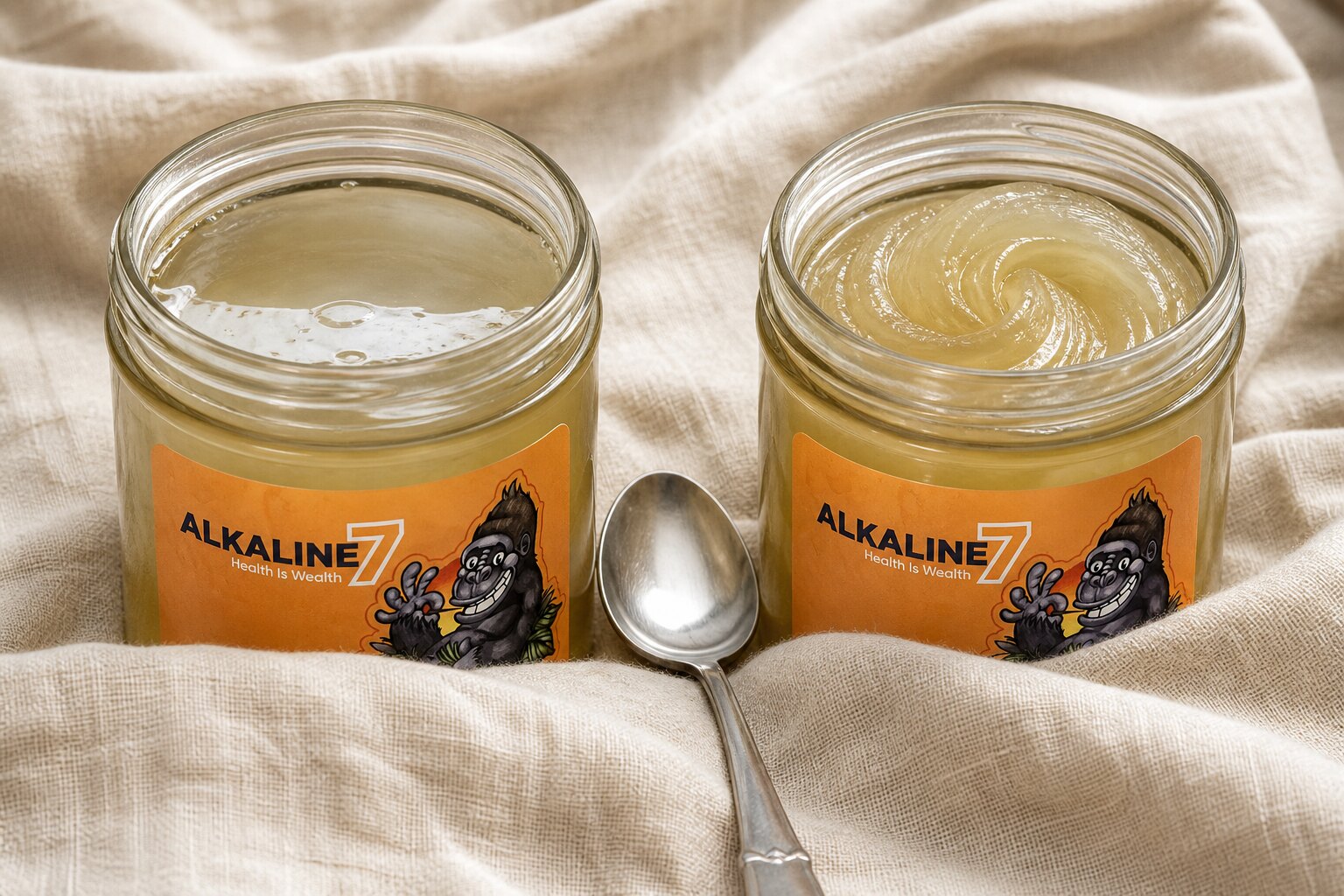
Troubleshooting: texture, symptom by symptom
| What you’re seeing | Likely cause | What to do |
|---|---|---|
| Thin layer of clear liquid on top | Normal syneresis — the carrageenan mesh releasing water | Stir it back in, use as normal |
| Large pool of liquid, gel stays broken however much you stir | The gel structure has broken down | Discard the jar |
| Gel noticeably looser after thawing | Documented freeze-thaw water release in carrageenan gels | Stir or blend briefly; best in blended recipes |
| Gel frozen solid in the refrigerator | Fridge too cold, or the jar sitting against the rear cold wall | Move it forward a shelf; check with an appliance thermometer |
| Too firm to scoop | Cold plain gel sets firmest | Let the jar stand 3–4 minutes, or scoop with a spoon warmed under the tap |
| Gritty or sandy mouthfeel | Under-rinsed or under-blended seaweed, or fine root particles in the darker herbal blend | Blend the gel with a splash of liquid before use. Grit in a plain jar is worth telling support about, with your order number |
Sources
- FAO, Production, Properties and Uses of Carrageenan (Chapter 3) — syneresis and freeze-thaw water separation; accessed 2026-08-22.
- “Carrageenan: structure, properties and applications with special emphasis on food science,” PMC (PMC12203331) — gelation on cooling, kappa/iota/lambda gel character, syneresis; accessed 2026-08-22.
- Carbohydrate Polymers, Influence of cations on texture, compressive elastic modulus, sol-gel transition and freeze-thaw properties of kappa-carrageenan gel — accessed 2026-08-22.
- “Sea Moss Gel Expiration: How to Tell If It’s Gone Bad,” Mermaid’s Magic Sea Moss (mermaidsmoss.com blog) — normal versus abnormal separation, graininess; accessed 2026-08-22.
- The printed Alkaline7 jar label — the ingredient panels and the closing line this is a natural product, contents may vary.