Two ways to keep a wet food safe: make the environment hostile — usually by lowering the pH — or keep it cold enough that growth slows to a crawl. That single choice decides whether a jar waits in your pantry or your fridge, how it ships, and how long it keeps. Neither is a quality grade.
What we verified — 2026-10-01
The regulatory framing is quoted from 21 CFR 114.3, the federal acidified-foods definition, including its explicit exclusion for refrigerated products. Every brand statement in the shelf-life table is that brand’s own published wording, re-checked on 2026-10-01 against the pages listed under Sources. The Alkaline7 row reflects the store’s published 3-to-4-week refrigerated window. Competitor wording changes without notice; check the seller’s current page. Nothing here is a nutrition comparison or a claim that either path produces a better food.
The problem both approaches solve
A wet, low-acid food held at room temperature is a hospitable environment for microbial growth. Manufacturers have two broad levers: make the environment hostile (usually by lowering pH or reducing available water), or keep the product cold enough that growth slows to a crawl. Pick one and build the operation around it.
Path one: pH control. The U.S. acidified-foods regulation defines the category precisely. Under 21 CFR 114.3, acidified foods are “low-acid foods to which acid(s) or acid food(s) are added,” having “a water activity (a<sub>w</sub>) greater than 0.85 and … a finished equilibrium pH of 4.6 or below.” That 4.6 line is where the organisms of greatest concern in shelf-stable wet foods stop growing. A manufacturer on this path adds acid, verifies the finished equilibrium pH and documents it. Citric and ascorbic acid are common acidulants as well as flavor and color agents; their presence on a panel alone does not tell you a product’s pH or how it is controlled.
Path two: refrigeration. The same regulation carves refrigerated products out of that framework: Part 114 expressly excludes “foods that are stored, distributed, and retailed under refrigeration.” For a refrigerated gel, rather than engineer the product to survive an ambient pantry, the maker relies on cold and accepts the constraints: cold packing, one fast service level, and a jar that must go into your fridge on arrival.
Why this changes what you buy, not which is “correct.” A pH-controlled gel can sit on a grocery shelf, ride in a normal parcel, and wait in your pantry. A refrigerated gel cannot, and in exchange it needs no acidification step in its formula. Neither path predicts taste or texture. What it predicts is logistics: whether you can buy it on a Tuesday grocery run, whether it survives a hot mailbox, and whether you need shelf space or fridge space.
One note on both. Once either jar is open, refrigeration is required. The whole difference is the unopened jar.
Which should you buy?
Three lines, honest in both directions.
- Buy shelf-stable if you are rarely home for deliveries, buy your groceries in person, or want to keep a spare jar for months before opening it. A cold-shipped box on a porch for two days is a failure mode you can simply not buy into.
- Buy fresh if you have fridge space, a predictable delivery address, and want a jar that relies on refrigeration rather than formulation for shelf life. The handling requirement is only a cost if the fridge isn’t already where your morning starts.
- Buy either if what you actually care about is flavour, format or price — because the preservation path does not decide any of those. Read the panels and the price per ounce instead.
For the brand-level version of this decision — one refrigerated gel against one shelf-stable one, with the price arithmetic in the open — see Alkaline7 vs. True Sea Moss.

What do sea moss brands publish about shelf life?
Published figures vary widely across the category, which is much of why shoppers are confused. These are the brands’ own statements, quoted as of 2026-10-01.
| Brand | What it publishes |
|---|---|
| True Sea Moss | Unopened: “Keep in a cool, dry place. It will remain shelf-stable for up to 12 months.” Opened: “Refrigerate once opened. Enjoy within 3-4 weeks for best results.” |
| Seamoss Global | “Sea moss gel usually lasts about 2 to 3 weeks in the refrigerator when stored in a clean, airtight jar,” with freezing extending storage “up to several months” |
| MossBoss | “Refrigerate overnight before opening” on arrival; refrigerated gel “is best if used within 12 weeks”; frozen “up to 12 months from the date of purchase” |
| Alkaline7 | “3 to 4 weeks refrigerated. Keep the jar sealed between uses and use a clean spoon each time.” |
The spread — from “shelf-stable for up to 12 months” unopened to “2 to 3 weeks in the fridge” — is not brands disagreeing about one product. It reflects different products and processes: a gel heat-treated or acidified for shelf stability behaves differently in a warehouse than a fresh refrigerated gel, and the two carry different handling instructions. The one that matters is on the jar in front of you.
And a myth worth killing while we are here: “sea moss gel lasts for months at room temperature.” Not a fresh refrigerated gel. That claim conflates three different things — dried sea moss, which is genuinely shelf-stable because there is almost no free water in it; heat-treated or pH-controlled gels sold by some brands, which are engineered for it; and fresh refrigerated gel, which is not. Check which one you have before you leave a jar out.
What “preservative-free” does and doesn’t tell you
It is the phrase most often attached to both paths, and it means less than it looks.
A refrigerated gel typically has no preservative in the ingredient list because refrigeration is doing the preservation. That is a statement about where the shelf life comes from, not a statement about quality. A pH-controlled gel may also carry no listed preservative — acidulants like citric acid are usually listed as ingredients rather than as preservatives, and a low finished pH is a process control rather than an additive.
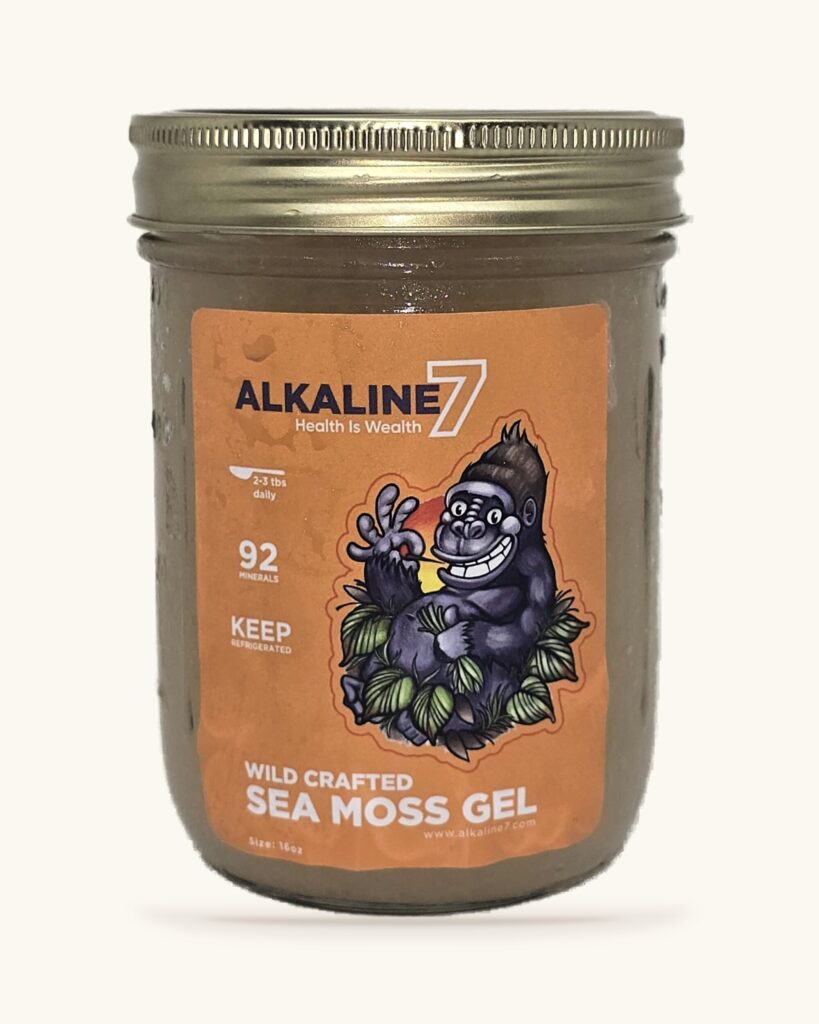
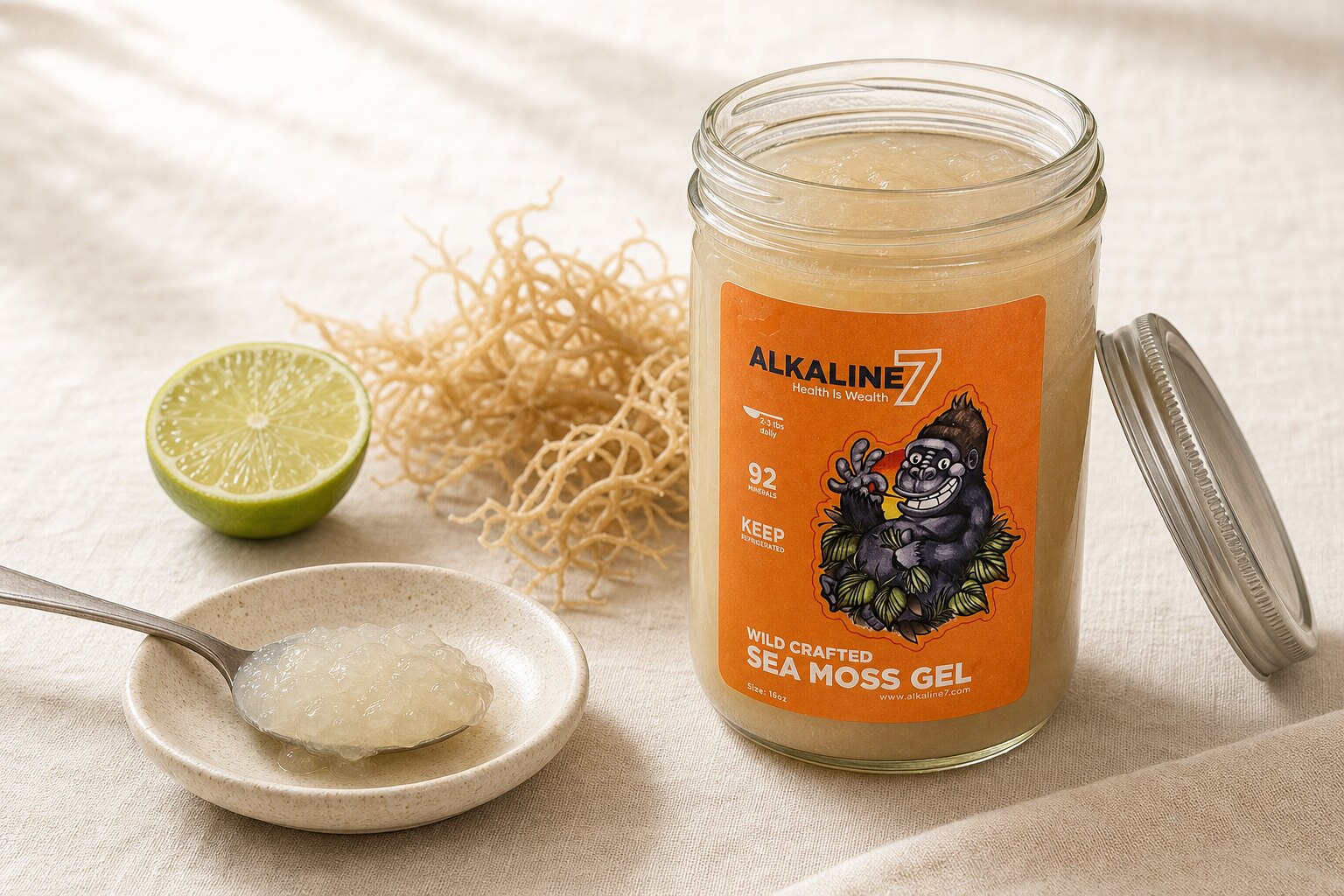
So: read the panel for what is in the jar, read the storage line for how it is kept safe, and treat the two as separate questions. An Alkaline7 jar relies on refrigeration rather than formulation for shelf life, which is what KEEP REFRIGERATED on the front is telling you.
Sources
Category shelf-life statements, brands’ own published wording
- True Sea Moss, FAQs — “How should I store my gels?”; accessed 2026-10-01.
- Seamoss Global, Sea Moss Gel Shelf Life: How Long Does It Really Last? — accessed 2026-10-01.
- MossBoss, Frequently Asked Questions — accessed 2026-10-01.
Regulation
- 21 CFR 114.3, Definitions (acidified foods; refrigerated-distribution exclusion), eCFR — https://www.ecfr.gov/current/title-21/chapter-I/subchapter-B/part-114/subpart-A/section-114.3 — accessed 2026-08-22.
Alkaline7 product record
- The printed Alkaline7 jar label — the printed KEEP REFRIGERATED instruction and the ingredient panels.
- Alkaline7 published FAQ, alkaline7.com — the 3-to-4-week refrigerated window; accessed 2026-10-01.